
Cat Care 101

Here is some basic information on cat care - things you'll need to get started and some additional information to get you by your first few weeks! I've also included a section on considerations if you are thinking about possibly declawing your cat.
Other links to get cat care information: Doctors Foster and Smith offer supplies and advice on how to train your cat. The US Humane Society offers many articles on how to care your cat, including information on how to introduce a new cat to the family. About.com has some good information on cat behavior as well.
Getting Started!
List of things you'll need to pick up the day you get your new cat:
- Cat food - dry and wet
There are different types of food for different age ranges. Make sure you get the right age range of food. Kitten food is a lot more nutritious to support their growth; older cats who eat kitten food tend to gain a lot more weight and too much weight gain can be very unhealthy! Also, try to get varying flavors and brands, so your cat doesn't get too used to a single type of food (and won't eat others later).
- Litter box - at least one
Place the litter box in a convenient location. You want to encourage your cat to use the litter box. Placing it in the garage when most of the family activities occur upstairs is a bad choice of location. There are different types of litter boxes, open top and closed top (some even have doors). Cats can be picky about the type, so if your cat dislikes the first type you purchase, try a second box of a different type. Get a box that is bigger if you have younger cats who are still growing. They need to be comfortable or else they won't use the box. Bad habits that are developed can be very hard to break!
- Cat litter
Obviously, for your box. Cats aren't too picky about their litter, but you'll want to experiment with different types of litter and find out which one is a good match for your needs. Flushable and non-flushable are both available on most store shevles.
- Toys
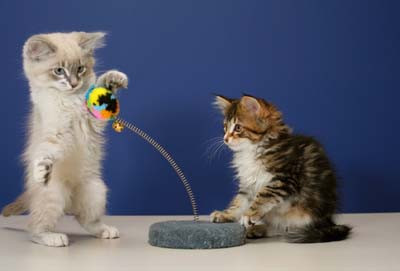
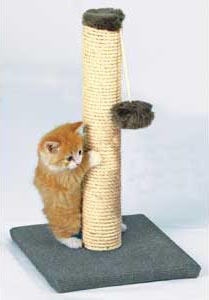
In addition to the general balls and furry objects tied to a string, a cat tree is a good buy. Get a tall cat tree so that your cat can stretch with it. It also promotes climbing, and can be a good exercise tool for your cat during the day to keep himself occupied.
Food & Diet
Feed your cat both wet and dry food. Wet food is very important to a cat's diet as it provides additional moisture. Cats generally don't drink enough water and the wet food can provide additional water to prevent urinary tract infections. Dry food helps teething. Cats also need something to chew on, and dry food provides this functionality. You can also buy frozen cat food, which is just frozen, raw meats. Get a variety of flavors - you don't want your cat to get used to a single flavor or brand of food.
Scratching
Surprisingly enough, my cats don't scratch. We've bought scratching posts, cardboard scratchers, and a cat tree; they just have no interest in it. Buy alternative objects so that your cat doesn't scratch your furniture - or you. If you cat is fixated on a certain area of a furniture object, cover it with aluminum foil and place an acceptable scratchable object nearby.
... So why not just declaw?
When a cat is declawed, a part of the knuckles are actually removed. Think about losing the bone between your fingertips and your first knuckle. Can you imagine how things would be? Cats love to crawl and run; when they lose their claws, they lose the ability to do a lot of what would be considered an every day activity. In all honesty, it's best to train your cat to not scratch inappropriate objects; declawing is an "easy way out" as described in this article by a cat vet. Some cats no longer use their litter box after being declawed since their paws are too sensitive to the feel of the litter. This becomes a very, very big problem. In addition, a declawed cat is no longer suitable to be an outdoor cat. In fact, it is not recommended to let a declawed cat outdoors. Most adoption contracts request that you do not declaw your cat.
Grooming
While cats have the ability to "clean themselves", they may need additional grooming from the parents. Cats who don't scratch either posts or scratch boards will most definitely need their nails periodically checked and clipped. Long nails can not only break, but they also split and can cause your cat a great deal of pain. You can either take your cat into the vet or other animal grooming service to get their nails clipped if you find the task too daunting. You can, however, clip their nails yourself. Washington State University's Vet School has a great tutorial complete with pictures.

I've used both cat nail clippers and my own nail clippers to cut cat nails. Whatever you choose to use, always use a sharp set of nail clippers. Cats don't really like their nails cut, so it's important that they don't feel like they are being "attacked" to have their nails cut. I tend to wait until my kittens are tired and sleeping. Then I'll push out each one of their nails and cut them quickly. They tend to be a little resistent, but at least they're not fighty!